
2024.09.03
Hello everyone. My name is Yosuke Kamata. I am the fourth-generation owner of Kamata Hakensha.
Are you familiar with chef’s knives?
A chef’s knife is a type of all-purpose knife, slightly narrower and more streamlined than the commonly used Santoku knife (all-purpose knife).
All-purpose knives are for home use, while chef’s knives are used by professionals. Consequently, chef’s knives come in a wide range of sizes, from small to large.
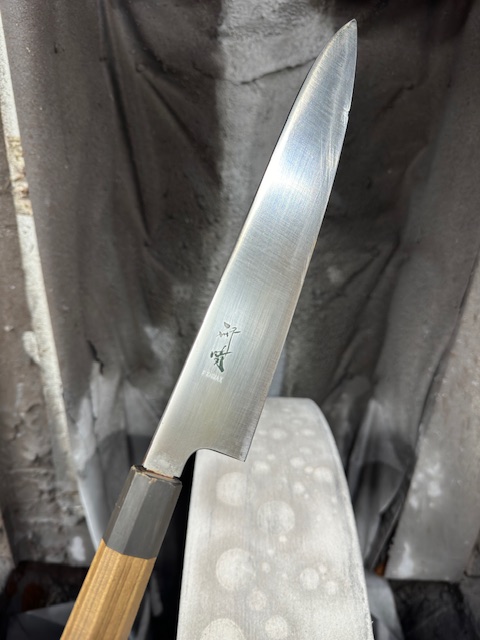
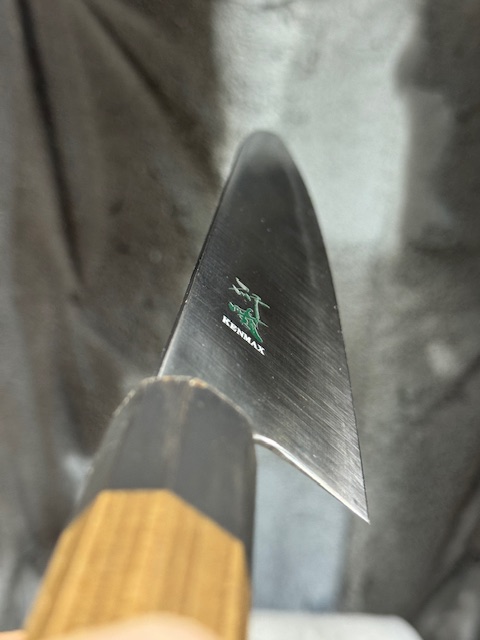
The knife shown in the photo is one of the products we offer. This particular knife was brought to our shop for resharpening.
VG10 Japanese-handled chef’s knife, water buffalo octagonal handle, 240 mm blade length
VG10 is the name of a high-quality stainless steel manufactured by Takefu Special Steel.
This steel combines high hardness with excellent durability, offering not only superior sharpness but also outstanding wear resistance.
VG10 is a typical steel material used for high-quality knives, from home use to professional use.
Please note the shape of the handle of the knife shown in the photo. This is a Japanese-style handle that is commonly used for Sashimi knives (fish-slicing knives) and Deba (butchering knives).
This model is called a Japanese-handled chef’s knife.
How does a Japanese handled chef’s knife differ from a typical chef’s knife with a wooden handle secured by rivets?
The difference is the blade thickness.
Japanese-handled chef’s knives are mainly used by washoku (Japanese cuisine) chefs. They are often used to slice vegetables thinly and carefully, so a delicate cutting edge is required.
To achieve this, a Japanese handled chef’s knife is designed to be thin overall from the spine to the tip.
If the blade were too thick, cutting wide vegetables like Japanese radish could easily cause the flesh to split. Therefore, a thinner blade is preferred for Japanese-handled chef’s knives.
Until now, we have explained Japanese-handled chef’s knives as described above. However, the difference between Chef’s knives and Japanese-handled chef’s knives has become less clear recently.
This is because overseas customers have started to seek out Japanese knives.
The handle style of these Japanese knives is very popular with overseas customers, as it evokes a sense of “traditional Japan.”
With conventional thin-bladed chef’s knives, issues such as edge chipping tend to occur more frequently.
For this reason, Japanese knife manufacturers have begun attaching Japanese knife handles to blades that are the same thickness as regular Western knives.
Nowadays, there is almost no difference in the blades between chef’s knives and Japanese-handled chef’s knives.
Today, when explaining the difference at our shop, we simply explain that the knives feature a different design.
Because kitchen knives are tools, the way they are regarded and the expectations surrounding them have gradually evolved depending on the users and their needs.
Perhaps this represents the true essence of knives as tools.
I hope you found this feature informative. I’ll see you next time!
Yosuke Kamata
Fourth-generation owner of Kamata Hakensha (specialty knife shop on Kappabashi Dougu Street)
Release of Photobook on Japanese Knife Artisan Kenji Togashi | The World of Sakai Forged Knives and Hontanzo (Hand-Forging)
https://www.kap-kam.com/en/blog/forge-craftsman-kenji-togashi/
© 2022 Kamata Hakensha All Rights Reserved.