2024.11.09
Hello everyone.
Today, I’d like to talk about a traditional Japanese kitchen knife known as the single steel knife.
Single steel knives refer to knives forged from a single piece of steel.
However, not all knives made from a single piece of steel are worthy of the name.
In fact, the manufacturing method differs from that of commonly sold knives.
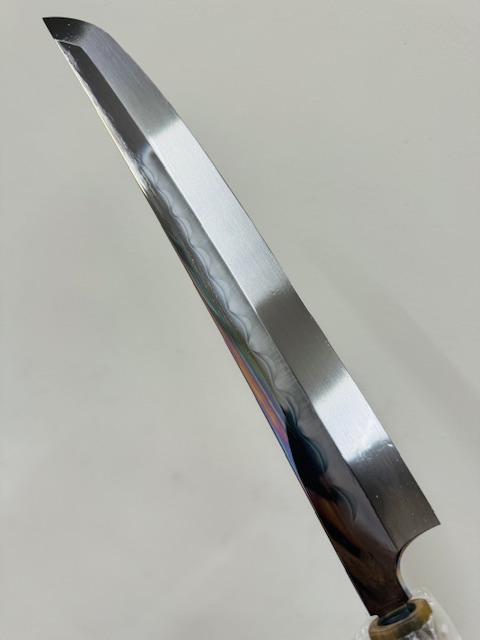
The knife shown in the photo is a single steel sashimi (fish-slicing) knife made in Sakai City, Osaka.
Shirogami #1 (White Steel #1) Sakimaru Yanagi (rounded tip single-edged slicing knife), 330 mm blade length, Mizu-honyaki (water-quenched single steel knife), with Joukokutan (premium ebony) handle
It is truly exquisite, isn’t it?
In Sakai City, Osaka, the main manufacturing method for knives is a forging technique called Hontanzo (hand-forging), which involves hammering steel to form the blade.
The knife in the photo is also made by forging and stretching a single piece of high-quality steel.
While that process already requires extraordinary skill, the most difficult part of making single steel knives is the Yakiire (quenching) process.
Quenching is the final step in the knife-making process, in which the blade is heated to a high temperature until it glows red, then rapidly cooled. This induces a chemical transformation in the steel, bringing out its hardness.
However, if the entire material were to be quenched, the knife would be weak to impacts and prone to chipping.
Therefore, craftsmen apply a clay-like mixture from the spine to the middle of the knife to intentionally prevent quenching of certain portions. This technique is known as Tsuchi-oki (clay coating).
As a result, the single piece of steel is transformed into a soft layer and a hard layer.
The soft layer cushions impacts across the entire blade and reduces the risk of cracking.
When looking at the knife in the photo, you can see ripples beginning in the middle of the blade. This is the border created by the clay coating.
Although this technique may seem simple when described in words, it is actually an extremely difficult technique.
Only a select few blacksmiths in Sakai City, Osaka, are capable of this technique.
Previously, I have introduced Kenji Togashi, a craftsman from Sakai City who is an expert in traditional techniques. Togashi said it took him seven years of trial and error to master the skill of making single steel knives.
Since only a limited number of blacksmiths are capable of making single steel knives, being able to forge one is a testament to their high level of skill.
Furthermore, the price of a single steel knife is an order of magnitude higher than that of a regular knife. At the current market price in 2024, these knives range from 200,000 to 300,000 yen. Consequently, only a few professional chefs are willing to buy one.
However, for chefs who are committed to perfecting washoku, single steel knives are a highly desirable item to own one day.
Personally, although I work with countless knives every day, I sometimes find myself captivated by single steel knives delivered to our shop.
Single steel knives represent the culmination of artisanal techniques and are worthy of use in washoku, the world’s most refined cuisine.
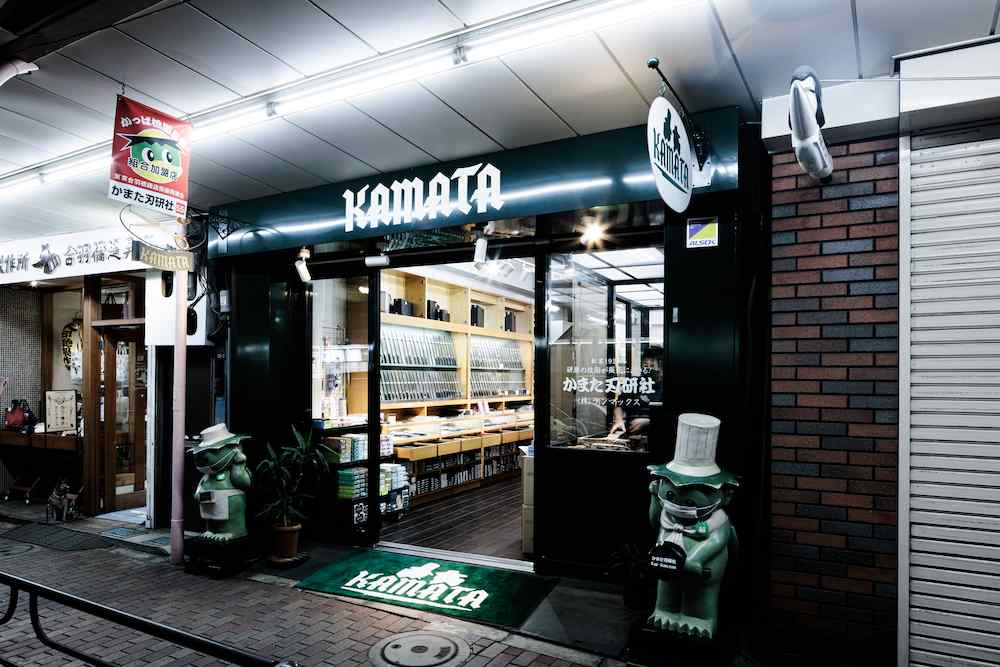
At our store on Kappabashi Dougu Street, we display single steel knives in the finest cases for viewing by our customers.
I am proud that no other store on Kappabashi Dougu Street has such a wide selection of single steel knives. Please be sure to take a look at these knives when you visit.
I hope you found this feature informative. I’ll see you next time!
Yosuke Kamata
Fourth-generation owner of Kamata Hakensha (specialty knife shop on Kappabashi Dougu Street)
What is a SPG STRIX Knife? A detailed explanation of characteristics, price, and sharpness of the new steel
https://www.kap-kam.com/en/blog/what-is-the-new-steel-material-spg-strix/
© 2022 Kamata Hakensha All Rights Reserved.