
2024.09.18
Hello everyone. Today, I’ll be talking about Japanese knives.
Japanese knives are particularly unique among Japan’s traditional blades.
As washoku (Japanese cuisine) gains popularity worldwide, there is also growing interest in Japanese knives that are essential for washoku.
So, what exactly makes Japanese knives so exceptional? I will introduce a few key points.
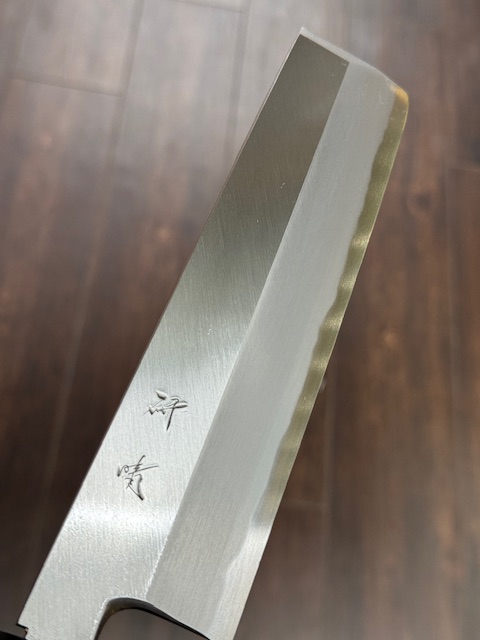
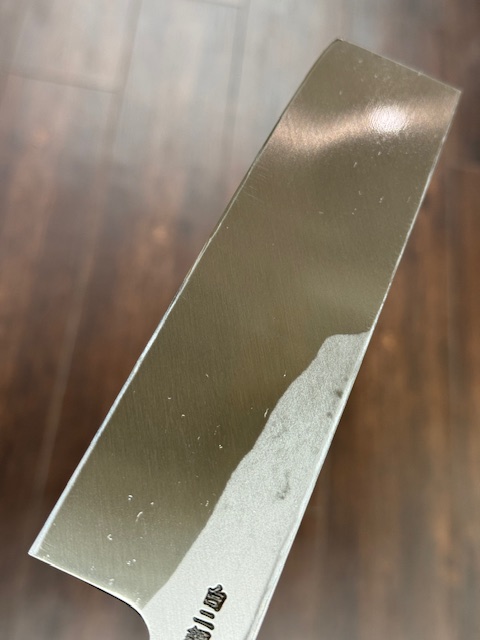
*Reference image: Toho Thin Blade, Hontanzo (hand-forging), Shirogami #2 (White Steel #2), 195 mm blade length
Japanese knives mainly have single-edged blades. Unlike double-edged knives, single-edged knives are not all-purpose blades; instead, they have special shapes designed for specific tasks.
Yanagiba (single-edged slicing knives) are suitable for sashimi, Deba (butchering knives) for filleting fish, and Usuba (thin-bladed vegetable knives) have thin blades designed for cutting vegetables.
The blade length, thickness, and width are designed to optimize performance for specific purposes.
Although Japanese knives can be difficult to master, a proficient user will be able to perform extremely delicate tasks.
Hand-forging is the forging technique of heating two different materials, steel and mild steel, to a high temperature of approximately 1,000 °C and then hammering the materials together to form a bond.
In this way, traditional Japanese knives are made from a two-piece structure of steel and mild steel.
To maximize the sharpness of the steel, the blade is single-edged and thin, while the flexibility of the mild steel absorbs impacts and prevents chipping.
This two-piece structure was developed from the pursuit of functional efficiency.
Although the technique is easy to describe, it is extremely difficult and requires a high level of skill.
The cutting edge on the front of a Japanese knife is essentially flat.
The back side has a subtle hollow known as an urasuki (back hollow). The back hollow ensures that the cutting edge makes full contact with the surface being cut.
This structure allows for efficient sharpening of Japanese knives using a square whetstone. Sharpening follows a simple principle: the flat surface of the knife is aligned with the flat surface of the whetstone.
The person who first conceived the structure of the Japanese knife was remarkably wise.
Furthermore, the design clearly reflects the fact that a blade is a tool designed to be sharpened.
As described above, Japanese knives are made with a deep understanding of the user’s needs.
Japanese knives originated from the uniquely Japanese trait of pursuing perfection.
It seems only natural that Japanese knives have spread and gained recognition worldwide.
I hope you found this feature informative. I’ll see you next time!
Yosuke Kamata
Fourth-generation owner of Kamata Hakensha (specialty knife shop on Kappabashi Dougu Street)
What’s the difference between a Gyuto (chef’s knife) and a Wagyuto (Japanese-handled chef’s knife)? Introducing recommended knives
https://www.kap-kam.com/en/blog/gyuto-and-japanese-gyuto-knife/
© 2022 Kamata Hakensha All Rights Reserved.